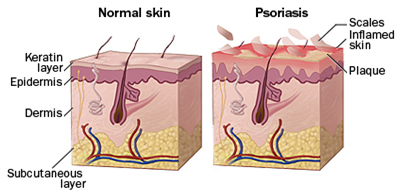
Did you know that 7.5 million people in the United States suffer from psoriasis? I certainly didn’t, until I was one of them. Psoriasis is a chronic, autoimmune inflammatory disease that appears on the skin, occurring when the immune system sends out signals that speed up the growth cycle of skin cells. Common symptoms include red patches of skin covered with silvery scales, small spots of scaling, dry, cracked skin that may bleed, itching, burning or pain, and thickened, pitted or ridged nails. Symptoms often appear on elbows, knees and scalp and may occur in cycles, flaring for a period of time and then subsiding.
About 10 years ago, I developed a patch of irritated skin on my scalp that as you can imagine, was very frustrating. I decided to see a dermatologist to figure out what was going on, and was diagnosed with psoriasis. Eventually, the psoriasis expanded to cover my arms, stomach and other parts of my body. For me, things got worse before they got better; I stopped wearing sleeveless clothes and shorts and even changed my hair to hide the impacted skin.
Upon my diagnosis, I immediately started cycling through treatments, trying to find something that could relieve my symptoms and control my psoriasis. I found some things that worked, and some that didn’t.
I tried many different treatments in an effort to manage my psoriasis. Eventually, my doctor told me about a new treatment option: OTEZLA®. It is a newly-approved oral therapy for the treatment of moderate to severe plaque psoriasis.
Aside from medications, I learned that certain lifestyle modifications can contribute to an overall healthier life, which may help manage psoriasis symptoms too. This includes maintaining a healthy weight by managing diet and getting adequate exercise, minimizing stress, getting enough sleep and avoiding unhealthy behaviors like smoking and excessive alcohol consumption.
Learning to manage my chronic condition wasn’t easy. If you are one of the many people in the US that have psoriasis, remember: stay educated about your disease and about ways to manage your symptoms. Additionally, be sure to have transparent conversations with your doctor and be an advocate for yourself and your health!
This is a guest post provided by: Laura M.